08 June 2013

Should I stay or should I go now?

One of the reasons I chose to move to Ireland is there is the possibility of obtaining a long stay visa without having employment (i.e. a work visa.)   This blog post is about the process or as it turns out, what is quite a confusing process since not everyone involved knows the process.  I wanted to post my experience in case anyone in the same position as I am is looking to immigrate to Ireland.

The type of visa I am applying for is called "Permission to Remain" under the category of "Self Sufficiency" - retired person, long term visitor, or a dependent of a person already living here - and is valid for up to a year.  You can reapply each year for an extension and after 5 years, you can apply for permanent residency. That's not a choice in the UK, as you have to have a work visa or be married to a UK resident.  I did all kinds of research before leaving, on the Irish government website, as well as several expat websites.  I knew the main factor is that you have to prove you are self-sufficient financially and aren't reliant on the Irish government to live.  From what I read, during the Celtic Tiger or "boom years", their borders were almost completely open and people poured in.  However, now that the boom is over, they are quite strict about who stays and who goes.

There is a pamphlet on the Irish Naturalisation and Immigration Service (INIS) website entitled "Permission to Remain: For Non-E.E.A.(European Economic Area) Nationals" and the directions are quite clear.  According to the pamphlet, you have to obtain permission to remain from the Minister for Justice, Equality and Law Reform and "...this can be done by reporting to your local Immigration Officer...in the district in which you reside."  You need 1) A valid passport; 2) Evidence that you have sufficient funds with which to support yourself and any dependents; 3) Any information requested in connection with the purpose of your arrival in the state; and 4) Private medical insurance to cover your stay in the State."  Again, it states you must be "...in a position to show that you have sufficient resources to cover your stay in the State without recourse to public funds, services or State benefits." And, you must "...report to your local Immigration Officer with details of your future intentions and sufficient evidence of the above."  

All of that is pretty clear, other than the fact that they don't state an exact dollar amount you need to have in the bank.  I heard from 2 American couples that they asked their local Immigration Officer and was told it was 25,000 euros (the equivalent of $33,000) either in the bank or coming in on an annual basis.  I am good with that, but as you will see further down, that's not all you have to have.

When you come to Ireland from the U.S., there is no visa required, as long as you are staying up to 3 months as a tourist.  However, when I arrived in Dublin, the Immigration official at Customs stamped my passport for 1 month instead of 3.  I was then told by the Customs Agent that I needed to go to Cork City with all my documentation and "register."  This was confusing, as I had corresponded with several Americans who said you have to write a letter to the office in Dublin once you arrive in Ireland.  This in itself was confusing, as the pamphlet from the government says you need to show your documentation to the local Officer, not the office in Dublin.  Thinking the process must have changed, I went into Cork a few weeks after I arrived.  After standing in line for almost an hour, I was told I didn't need to register at all.  I was told by the Immigration Officer in Cork that I needed to send a letter requesting an application number, then once I received the number, I was to show my documents to the local official in Fermoy near the village where I was living. Fair enough.  Off to write my letter to Dublin.

I sent the letter off to Dublin and since the date stamped in my passport was almost up, I made an appointment with the local Immigration Officer to see about getting it extended for the full 3 months.  I met with the official in Fermoy, who took my picture and entered my information in the computer, and explained that once I received the letter back from Dublin, I would be showing him my documentation.  He said it was not necessary for him to extend the stamp in my passport.  "They won't deport you....yet."  Now that was a relief.  After another month went by and I still hadn't heard from the office in Dublin, I went to see him again, and this time he agreed to stamp my passport through May 14th, giving me a total of 3 months in Ireland.  Just as I was leaving, I mentioned again that I hadn't received the application number and he said "You mean the approval."  I said I hadn't even sent my documentation in, as I was directed to only request an application number and that he would review my documentation.  Both he and the official in Cork had directed me to do the same thing.  He then said the complete opposite.  I was supposed to send all of my documentation to Dublin and they would make the determination.  He was only there to stamp my passport.  (The frustrating thing about all of these visits is that I took notes every time I was there and was certain I was following their direction.  Turns out they aren't familiar with their own direction.)  Off to write another letter and send my documentation to Dublin.  

Since I still hadn't received word from Dublin and it was getting closer to the end of my 3 month tourist visa, I decided to leave to visit Scotland.  I tried one last time to have the Immigration Officer in Fermoy extend my stay, as I know other Americans in the same situation who were granted extensions.  However, this particular official said it wasn't necessary.  As long as I kept the letter with me saying I was waiting for approval, I would be fine.  He also said it was alright to leave the country while waiting for the approval, something another American couple I met had heard was not allowed.  The day after I left for Scotland, the letter came from Dublin, and was forwarded to me.  More documentation was requested.  

This time, they requested: 1) Additional bank statements - back 6 months; 2) Evidence of private medical insurance; 3) A police background check on police letter head; 4) List of "Irish Associations/Connections"; and 5) A medical report detailing my current medical status.  This information is due to them on June 14th.  I already sent in the proof of medical insurance.  They obviously missed it.  I submitted my background check completed by an FBI-approved company (called a channeler), but the company I used did not supply the results on FBI letter head back in January.  The company does now, but the results of the background check are purged after just 30 days, so I would need to have my fingerprints re-done, submitted again, and re-pay the fee.  I could send my fingerprints directly to the FBI, but again, I would have to have my fingerprints done locally, repay the fee, then wait 6-8 weeks for approval.  I thought about doing all of this again, but decided I would explain in the letter what I already submitted.  Connections in Ireland?  Knowing someone or more than one someones in Ireland was never mentioned as a qualification, but I was able to scrounge up a few acquaintances.  Two people I met through the Instagram app and a very nice American couple who already obtained their Permission to Remain said it would be alright to provide their names. The letter from Immigration didn't ask for references, but rather "Connections" so I am hoping that the fact that I don't know these people well will not make a difference.  Regarding the medical check-up, I could have had a check-up done in Ireland, but didn't know at the time it would be requested.  I thought about having a check-up here in Scotland or even flying back to Ireland for the day and seeing a GP there, but decided I don't have the extra money to spend if I am just going to be rejected for another reason, such as the background check.  I'll submit the lab tests I had done right before leaving and see what they say.

As I have written to several friends and my family, the worst case scenario is that I spend 1/2 the year in the UK and 1/2 in Ireland, staying as a tourist.  Having to move back and forth is not the best scenario, but at least there is an option.  One interesting thing about all the coming and going.  Ireland and the UK are in what is called a CTA - Common Travel Area.  This means you can travel back and forth between countries without having to go through Border Control or Immigration.  So, when I left Ireland for Scotland, there was no one at the border to stamp my passport.  Therefore, there is no documentation of when I left Ireland.  As for the UK, you can stay up to 6 months as a tourist (3 more months than you can stay in Ireland.)  However, just as with there being no proof of when I left Ireland, there is no proof of when I entered the UK either.  One American woman I met said she flew to Amsterdam for the day, just to get her passport stamped, so she could prove she left the country.  Or was it that she entered the country?  Now I can't remember.  

In my "old life", I would have been quite stressed by now about all of the changes in direction regarding the approval process for Permission to Remain.  However, one of my main goals for my "new life" is to not become stressed over things I can't control.  All I can do is follow the direction I am given, submit the paperwork, and see what happens.  On that note...I will leave you with this collage of photos taken just the other evening.  


There is more to St Andrews than golf and Prince William.

I took a drive to St. Andrews, just 14 miles from where I am staying, the week after I arrived.  What a beautiful and amazingly calm and quiet place.  The students at the famed University of St. Andrews were studying and taking their exams that week, so that was possibly the reason for the quiet.  Montana State University (MSU), where I received my 2nd bachelor's degree, is certainly nothing like St. Andrews, but walking by the school buildings reminded me of those wonderful school days. I graduated from MSU in 1996, after receiving my 2nd bachelor's degree - this time in Nursing.  I was in my mid-30's then and took university much more seriously on my second go-around, likely because I was paying for it myself.   

St Andrews is located on the east cost of Fife in Scotland and is named after Saint Andrew the Apostle, the brother of Saint Peter.  The town has a population of 16,680 and during the university term, students make up about 1/3 of the population.  The University of St Andrews is the 3rd oldest university in the English-speaking world and the oldest in Scotland.  It was founded between 1410 and 1414.  It's student body is quite diverse with 30% of students being international.  I remember first learning about St Andrews when Price William began university there in 2001.  The school became quite popular, with an increase of 44 percent in applications. There were a total of 9,200 applications that year, the majority from women (some hoping to become the future Queen, I am sure), for 1,200 spots.  This became known as the "Prince William factor."

Tuition fees were not charged in the UK for higher education until 1998.  The fees per academic year for undergraduate programs in UK universities, not including room & board, books, etc., were initially £1,000/$1,500 in 1998 and increased to £3,000/$4,600 in 2012.  In 2013, fees went up to as much as £9,000/$14,000, depending on the university.  Out of curiosity, I looked up the fees at St Andrews.  They are £1,820/$2,800 if you are from Scotland, £9,000/$14,000 if you are from other countries in the UK, and £14,450/$22,500 for international students.  In comparison, Cal Poly State University in San Luis Obispo, where I received my first bachelor's degree back in 1986, now charges the equivalent of £5,000 or $8,523 per academic year. The University of California system charges £8,400/$13,200.  Montana State University, where I obtained my second degree, charges a bit less than the California State universities at £4300/$6,750 for residents, but non-residents (as I was back in 1996) pay a whopping £13,300/$20,715 a year.  Stanford University, where my nephew will be attending this year, is private and charges the equivalent of £27,440/$42,690 for tuition per year.  

Riley and I took a very long walk starting at the ruins of St Andrews Cathedral, a Roman Catholic cathedral built in 1158, and the centre of the Medieval Catholic Church in Scotland until the 16th century Scottish Reformation.  During the Reformation, Catholic masses were outlawed, and in 1559, the building was stripped of its altars and images.  By 1561, it had been abandoned.  
 
The east tower on the left and St Rule's Tower to the right

The Pends is a mid-14th century large stone gatehouse of the Augustinian cathedral-priory of St Andrews. 

We also walked by the ruins of St Andrews Castle that are situated on a cliff to the north of the town.  It was first erected around 1200 as a residence, prison and fortress for the bishops.  The majority of the ruins seen now are from 1549 to 1571.  

West Sands Beach was the set for the opening scene in the 1981 movie Chariots of Fire.  The scene was reenacted during the 2012 Olympics torch relay.

St. Andrews is known as the "home of golf."  Documents as early as 1552 show that golf was played on the links there. There are 7 golf courses, the most famous being the Old Course that dates back to medieval times and is an Open Championship course, at St. Andrews.  We walked by several of the golf shops and saw some golfers who had stopped for lunch, but we didn't spend time at the famed golf course itself. Odd fact of the day: In 1457, James II of Scotland banned golf because he felt that young men were playing too much golf instead of practicing their archery.  King James IV removed the ban in 1502 because he was a golfer himself.  

We passed by a coffee shop with a sign that said Prince William and the now Duchess of Cambridge Catherine (then called Kate Middleton) had their coffee there.  Being a closeted (or sometimes out-in-the-open) fan of the Royal Family, I spent a little time imagining what it was like when they both were in school there.  The paparazzi had agreed to let Prince William alone while he was in university and during their years at school, they were able to live a relatively normal (as normal could be) life. 


I was lucky enough to meet the most important "person" living in St. Andrews at the time - Hamish McHamish. Hamish is a ginger cat, born in 1999, who was originally "owned" by Marianne Baird, a retired BBC producer. When he was about a year old, he started spending more time away from home, spending most of his time in and around the houses and businesses on South Street. I was lucky enough to see him lounging in the window of a bookstore, one of his favorite places.


03 June 2013

Trip from Ireland to Scotland

On Monday, the 13th of May, we left for the long trip to Scotland. I was barely able to get everything packed in the car. Actually, I couldn't get everything in the car, so I ended up shipping 3 boxes to our new home in Ladybank. To accommodate my purchases since I arrived in Ireland, I bought a roof box for the Skoda, yet I still found it hard to fit everything in the car.  So much for living a simpler life!
Packed and ready to go.  Riley just barely fit in the backseat and the 2 kitties are in their travel carriers in the front passenger seat.

We left at about 10 am for the 4.5 hour drive north to Larne in Northern Ireland.  As mentioned in my last post, I decided to split the trip into 2 days. My hope was the cats would do better with an overnight stay.  We were booked into a B&B in the small town of Larne where the ferry was set to depart the next morning at 7 am.  The road trip took us up to Dublin, then north to Belfast, then 23 miles to Larne.  There is no border control when you cross from the Republic of Ireland (ROI) over into Northern Ireland which is part of the United Kingdom.  I must have missed the "Welcome to Northern Ireland" sign and only knew I had arrived in the new country when a received a text from my mobile carrier saying my phone would no longer work in Northern Ireland.  Since I was counting on Google Maps to get me to where I was going, I stopped into a Tesco grocery store to pick up a UK micro SIM card for my iPhone.  The scenery in Northern Ireland was beautiful and I wish I had time to explore more.  I hope to be able to visit again, sans pets, when I return in the Autumn. 
My copilot wasn't interested in being my navigator, so I had to rely on Google Maps.

The B&B in Larne was called Derrin Guest House and was easy to find.  Because I was a single (and yes, it costs more to be a single than a double), the room was small, but fine for 1 person.  Except I was 1 person plus a large fluffy dog, 2 cats, and all their paraphernalia.  With a large bed filling most the room, there was little room to walk.  

After settling in , I took Riley for a walk to a local park.  He was happy to be out of the car after the long journey.  I then parked him in his crate in the car, before heading into a local pub for dinner.  At the local Chequors pub, I had a nice large burger with chips (french fries) and chatted with some lovely people who were visiting from Australia - 2 adult sisters and their parents. They were on a 6 week, 5 country trip.  It was sweet when a young boy, with his Mum, came to my table to offer me a piece of his chocolate birthday cake.  He had turned 7 years old that day.
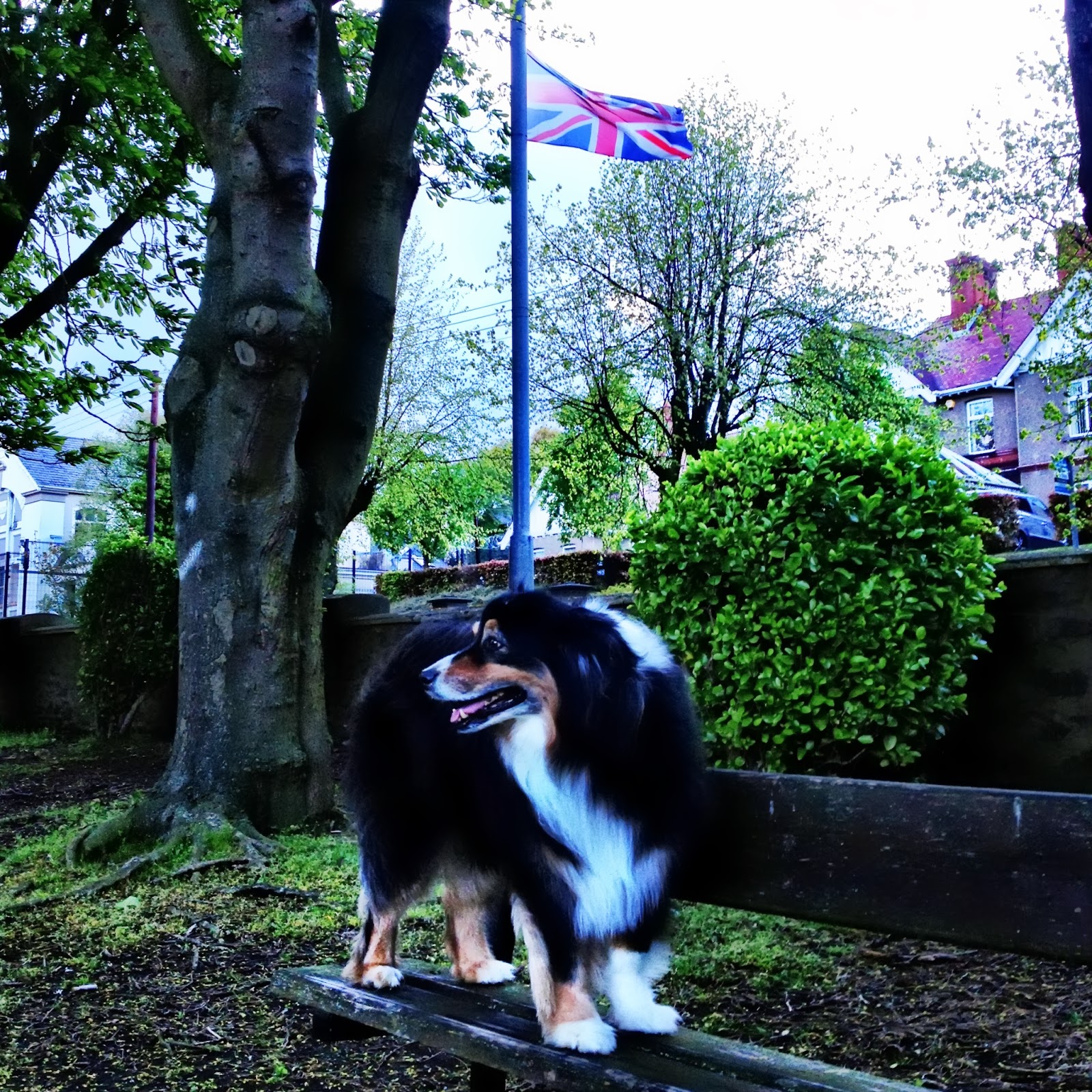
Riley at the park with the Union Jack flying in the background.

I planned to put the cats in the bathroom for the night to prevent them from hiding under the bed where I would have difficulty removing them at 5:00 am the next morning. My plan was not as brilliant as I thought it was.  Rather than being tired from the journey, Livvy and Bell ended up being wide awake and started to meow - very loudly - as soon as I had closed the door to the bathroom. Not wanting to disturb my neighbors, I finally let them out at about 1 am to roam free.  When the alarm sounded at 5:00 am, I had had no more than 2 hours of sleep.  On a positive note, the kitties hadn't discovered the under-the-bed hideaway, thank goodness. This made it easy to catch and crate them.    
Livvy on the left with Bell on the right.  They rode in their small crates that were situated inside the large crates they came over from the States in.

I wasn't certain how many other cars would be at the ferry landing, so we left at about 5:45 am.  I had paid extra for priority loading. This allows you to be the first to disembark.  At the security checkpoint, the guards checked the underside of our vehicle for explosives and used a wand to check me.  They weren't interested in using the wand on Riley. The gentleman in charge took one look at how full the car was and thankfully, did not ask to see inside the vehicle.  
Trucks disembarking from the ferry so the passengers traveling at 7 am could load.

The one way trip from Larne, Northern Ireland, to Troon in Scotland cost 130 euro ( about $170) and took exactly 2 hours.  It was a huge ferry with the passengers spread out all over the ship, so it felt as if there were few people on board.  The captain announced that it might get choppy once we were out to sea, but the only time I noticed the ferry's movement was when we arrived in Troon.  When I lived in Washington State back in the late 1980's, I loved taking the ferry to the different islands off the coast.  This was a much larger version of those ferries and still just as enjoyable.  I read a book, tried to sleep (unsuccessfully), and wandered around the ship, enjoying every minute.  
My view out the ferry window.

The photo above shows the large rock/island called Ailsa Craig.  It is 219 acres and located in the outer Firth of Clyde, between Ireland and the UK, just 10 miles from mainland Scotland.  It is sometimes known as "Paddy's Milestone" as it is the halfway point of the journey from Belfast to Glasgow, a traditional route of emigration for many Irish laborers seeking work in Scotland.  Much earlier, it was a haven for Catholics during the Scottish Reformation in the 16th century. Until the 1970-80's, it was inhabited by a few quarry workers, farmers, and lighthouse keepers.  The last inhabitant left in 1990 when the lighthouse became automated.  It is now a bird sanctuary and owned by The 8th Marquess of Ailsa of Scotland.  There is a ruined castle, small cottage, a lighthouse and a granite quarry that once provided the blue hone granite used to make stones for the sport of curling.  Since 2012, it is been for sale for 1.5 million pounds (about $2.2 million), a discounted price from the original 2.5 million pounds ($3.8 million). Quite a hefty price for a place with no running water, electricity or any other utility.  

Ours was the 2nd vehicle to disembark in Troon.  Just outside of Troon, I stopped to let Riles out to do his business.  It was cold and very, very windy, so Riles was happy to jump back into his crate for the last 2 hours of the trip.  We arrived at our new home at about 11 am.  The owner of the flat we are renting, Mike (one half of "Mike and Sharon") was there to welcome us.  Little did he know what he was getting himself in for!
The view about a mile before we arrived at our new home.
Riley happy to be almost there.


View of the annex (to the right of the main house) taken by a friend and posted on Instagram.  He was laughing that I came here, thinking I would have peace & quiet, and not knowing it was a haven for boys working on their toys in the garage.

Riley soaking up the sun in the garden.

First walk in the woods just a few houses down from where we are now living in Scotland.


10 May 2013

Off on another adventure already.

We have been in Ireland for almost a year and are off on a new adventure.  We are leaving Monday for Scotland for the summer months.  

For many years, I had hopes of moving to the UK.  Since my 20's, I had visited England many times, for holidays and to visit my great aunt Peggy who lived in Salisbury.  I thought it a beautiful country and looked forward to visiting Scotland and Wales.  In 2010, I had an opportunity to apply for a transfer to my former company's office in Cambridge. I seemed qualified for the position, but it was my pets who kept me from moving. Prior to 2012, pets entering the UK (and Ireland) were required to spend a great deal of time in quarantine upon arrival.  According to the UK government, this was to prevent rabies from reaching either of the 2 countries. Since I always had pets, I never made the move across the pond. That changed in 2012 when I read online that the UK and Ireland were eliminating the quarantine requirement.

Upon my arrival in Ireland in early 2013, I applied for a 1 year Permission to Remain under the category of "Self Sufficiency" (retired person, long term visitor - basically anything but a working person). If approved, there was the opportunity to reapply for an extension each year.  It wasn't possible to apply for this type of long-stay visa prior to arriving in the country, so it was a leap of faith to move, then apply to stay.  Even though I haven't received the approval from the Irish government yet, the immigration officer assigned to my area authorized me to visit Scotland until I heard back with an approval or denial.

When we come back to Ireland in the Fall (or Autumn, as it is known here), I will be looking to live in a different part of the country than where I am located now - farther west and hopefully near the coast.  I had originally hoped to find a rental home in County Kerry. I had visited in 2005 and found the area to be very beautiful.  However, I was limited to renting a house over the internet in order to have a place to go to when I arrived and there were none available in Kerry at the time.  Also, I was limited in my choices, I as required a pet-friendly rental, not easy in many parts of the world. Lastly, I needed to find a private owner, versus an estate agent, who would be willing to let me out of the contract if I wasn't approved to stay in Ireland.  I felt lucky in finding the cottage I am letting now, about 40 minutes north of the city of Cork.  The owners didn't mind about the dog and cats and the issue with the contract was not a problem.

Cottage near Castletownroche

The cottage has been terrific - modern, located in a quiet area in the countryside, and the perfect size for all of us.  It is located 1 mile from the small village of Castletownroche where there is a small butcher, post office (called An Post), Centra grocery store, an auto garage, and 3 pubs.  There were 2 larger villages, about 7 miles in either direction, called Fermoy and Mallow. I hoped to find some activities or groups to join there.  To date, I have been to a few activities in Mallow, such as a writer's workshop, history lecture, the local farmer's market, and a ceili (a get together with traditional Irish dancing). 
Village of Castletownroche and the River Awbeg


Fishing the River Awbeg at the base of the village, the Virgin Mary at the entrance to the road to our cottage, a beautiful sunset, and view from our back garden.

My cottage is the last in a row of 5 other cottages out in the countryside. I have made attempts to meet my neighbors, to no avail.  I don't think I am that frightening of a person, but those stories I read about the neighbors welcoming you with a cuppa tea or a glass of Irish whiskey just haven't materialized yet. 

The young couple living next door acquired 2 pups, a German Shepherd and a very vocal terrier, that have been barking throughout the day. Since I am home during the day, the repetitive barking was starting to wear on my patience.  I talked with the couple and offered to exercise their 2 pups during the day while they were both working, in the hopes wearing them out would cut back on the barking. The couple were quite nice, but did not take me up on my offer.  The young man's father lives up the road and owns a kennel with 55 beagles he uses twice weekly for hunting, so I think the neighbors are immune to the sound of barking dogs.  

I met a lovely young gal who lives with her parents at the end of the row of cottages. She was good enough to check in on my kitties when I took a 2-night trip to the west side of Ireland.  However, she is busy attending college and working 2 part-time jobs, leaving her no time to socialize with someone as ancient as myself.  

We are out in the country, with farms on both ends of the road.  With farms, come farm dogs, and in the case here...not so nice farm dogs.  There are 2 Border Collies at one end of the road that guard the entrance to their farm like it is Fort Knox.  In the other direction is a rather ferocious looking Rottweiler who is hard of hearing - a little hard for the farmer to call him off when he can't hear a thing. 

This has made dog walking a bit of a challenge, so we've explored the area for other options.  We have been to Doneraile Park, the Nano Nagle Center, and at the Donkey Sanctuary - all lovely places.  
Walking in the rain after the Killavullen Farmer's Market

Doneraile Court

Walkies with pals at the Donkey Sanctuary
On the trail around Nano Nagle Center

I do not place any blame on the nice people of Castletownroche.  They are busy working and living.  The extent of my conversations with the locals have been like this: "You must be from the States." "Yes, Portland, Oregon." Confusing looks on their faces. My guess is they are not familiar with where Oregon is located.  "Are you here on holiday?" "No, I have moved here to live." "Oh." And that's about it. I anticipate I would find others more open to meeting new people if I lived in the city rather than the countryside. For now, I will make the best of where we live. I hope, on our return from Scotland, we can find another area to settle.

On Monday, we will 5 hours north, through Dublin and into Northern Ireland, to the town of Larne where the ferry departs from. Though the trip to Scotland could be made in one very long day, I decided to break it up into 2 days for the sake of my health and sanity.  We will stay in a B&B in Larne, then load onto the ferry very early Tuesday morning. The ferry ride takes 2 hours to the small town of Troon. We will then drive 2.5 hour east to the village of Ladybank in The Kingdom of Fife.

Thanks to a virtual friend on Instagram, I was introduced to a couple who have an annex on their house for let. It will be a completely different experience for me, living with close neighbors again. I am much more used to chickens, turkeys, sheep and more recently, 2 voyeur horses across the road.  I believe it is time to brush up on my conversation skills!

For the trip, Riles and the kitties will be outfitted in their anti-anxiety Thundershirts. I only wish there was a Thundershirt for humans!


I most worry about the trip and new home for the cats, as their out-of-home experiences have consisted of short trips to the vet and the one very long trip from Oregon to Ireland.  Riles won't be a problem, as he goes happily anywhere I go. But, so far so good.  You can see from the pictures below, the kitties don't seem too traumatized by the site of their travel crate or one of the suitcases I started packing this afternoon.
Liv and Bell looking for their crate training treats.

Livvy says "Here we go again."

Come Monday, think good thoughts of us driving almost the entire length of Ireland, then across Scotland to our new home on Tuesday.  Bon voyage!

21 April 2013

Better late than never.

As soon as I decided to move overseas, I knew I wanted to take up blogging again.  For several years I wrote an online journal about my part-time career as a sheep farmer and enjoyed the opportunity to be creative and share my everyday life with whoever happened upon my writing.  I created this new blog in January, with plans to post daily about my plans, details and photos from the move itself, and of course, all my new experiences.  So much for good intentions.  Preparing for the move was more overwhelming than I imagined and the trip to Ireland was exhausting.  My health suffered tremendously.  After I arrived, my computer blew up the first time I plugged it in and though I didn't lose anything on my hard drive, my photos ended up duplicating and triplicating themselves and are now randomly stored on my iPhone, iPad, and in hundreds of folders on my new hard drive.  This was not going to be easy.  I have been keeping up with my posting on Instagram, under the username FilbertSheep, and vowed I would get the blog up and running sooner rather than later.  Now, four months into the new year, the blog is just now becoming functional.  The talented John Lennon said in song, "Life is what happens when you are making other plans."  In my case, my life happened while I was planning to blog about it.  So, better four months late than never, here are my thoughts on everything from how to or not to become an expat, my experiences in my new life in a different land, and details of my never ending search for more sheep.  I hope you will come along for the ride!
Riley and me.  The adventure has just begun.

26 January 2013

What's in a name?

Filbert is my pen name, chosen about 4 years ago when I began writing an online journal about my life as a part-time sheep and poultry farmer. At the time, it seemed safer to use a name other than my own.  In case, say, the boss at my "real job" wanted to know what I was up to, googled me & found my blog.  Reading about my dropping my cell phone in the mud outside the chicken coop when I was actually supposed to be seeing a customer didn't seem good for job security.

Filbert
I have a special fondness for the name "Filbert." Filbert was one of my favorite sheep in the flock of woolies I cared for over the past several years. Filbert, or Bert for short, was a beautiful silver Romney sheep, kept as company and a calming influence for the flock's breeding ram Buckeye. Filbert could be a worrier one minute and prancing joyfully like a deer through the pasture the next. He was the sheep that required the most patience to handle. Filbert was the sheep version of me.
Coated Bert

Bert just before shearing
Filbert is also the name most often used in Oregon for the hazelnut. The filbert is actually a particular species of the hazelnut, thinner and more elongated than the other rounder species. Oregon is known for its filberts, producing 99% of the hazelnuts in the United States, the 3rd largest country of producers after Turkey and Italy. When I refer to the filbert or to filbert trees, I am often mistaken for a native Oregonian, as natives of the state are more apt to recognise the name. Another fascinating fact about why I like "Filbert" is the name is thought to have originated because hazelnuts mature on or around St. Philibert's Day, August 20th, which just so happens to be my birthday.
A filbert about 1 month before harvest

"Our" filbert orchard
As my life descended into mild to medium chaos over the past 2 years, I often joked with friends about entering NUTSEC, my own mental health version of the Federal Witness Protection Program or WITSEC.  To keep me safe and difficult to locate, it made perfect sense for my NUTSEC name to be Filbert.